BCBC Local File-to-Agent — Reducing Friction Between Local Files and AI Agent Workflows
I built a small Linux utility because I kept encountering a very ordinary problem during AI-assisted development: I knew the artifact I needed existed somewhere on the workstation, but getting the exact file into the agent workflow was taking too many steps.
Sometimes I knew the filename.
Sometimes I only remembered a function, variable, configuration line, or phrase inside the file.
Sometimes I already had the exact path.
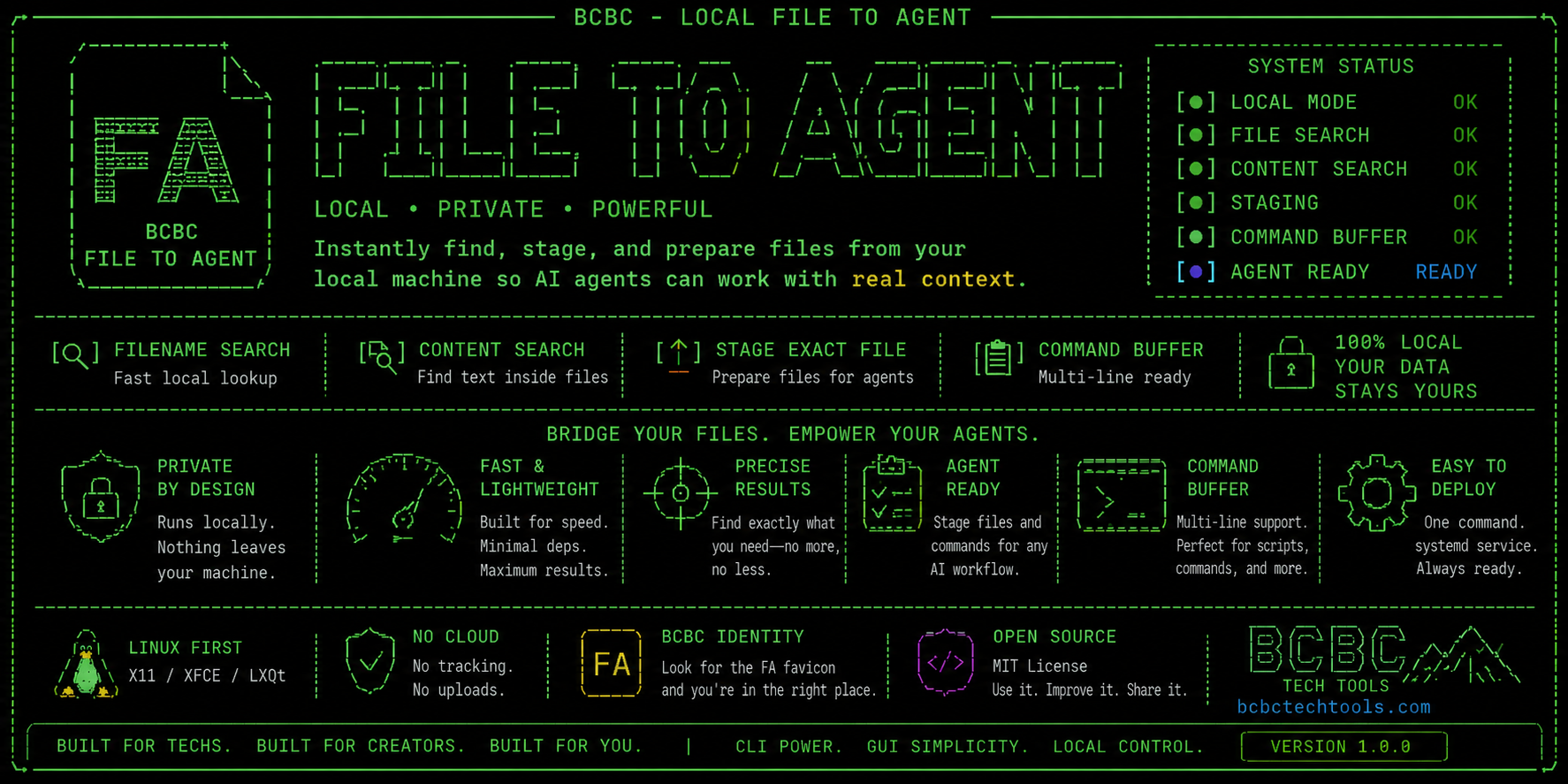
The tool is called BCBC Local File-to-Agent.
Find the correct local artifact, verify it, stage it, and get back to the engineering problem.
Current workflow
LOCAL WORKSTATION
       │
       ▼
┌─────────────────────┐
│ LOCAL FILE-TO-AGENT │
├─────────────────────┤
│ Filename Search     │
│ Content Search      │
│ Exact Path          │
│ Command Buffer      │
└─────────┬───────────┘
          │
          ▼
      Select File
          │
          ▼
      Stage Exact File
          │
          ▼
   Agent-Ready Artifact
The utility does not attempt to bypass the user or automatically inject files into an AI conversation.
Discovery and staging happen locally. The user still controls the final attachment or handoff.
Implementation
Browser UI
    │
    ▼
Local NGINX
    │
    ▼
Python Backend
127.0.0.1:8765
    │
    ├── Filename search
    ├── Content search
    └── File staging
The backend listens only on localhost by default.
Filename search is useful when I know something like:
common.py
Content search is more interesting.
If I remember:
preflight_proxy
but do not remember where I wrote it, the utility searches supported local source/text files and gives me the matching artifact.
That removes a surprising amount of context-switching during debugging.
A small native Dev Hub grew out of it
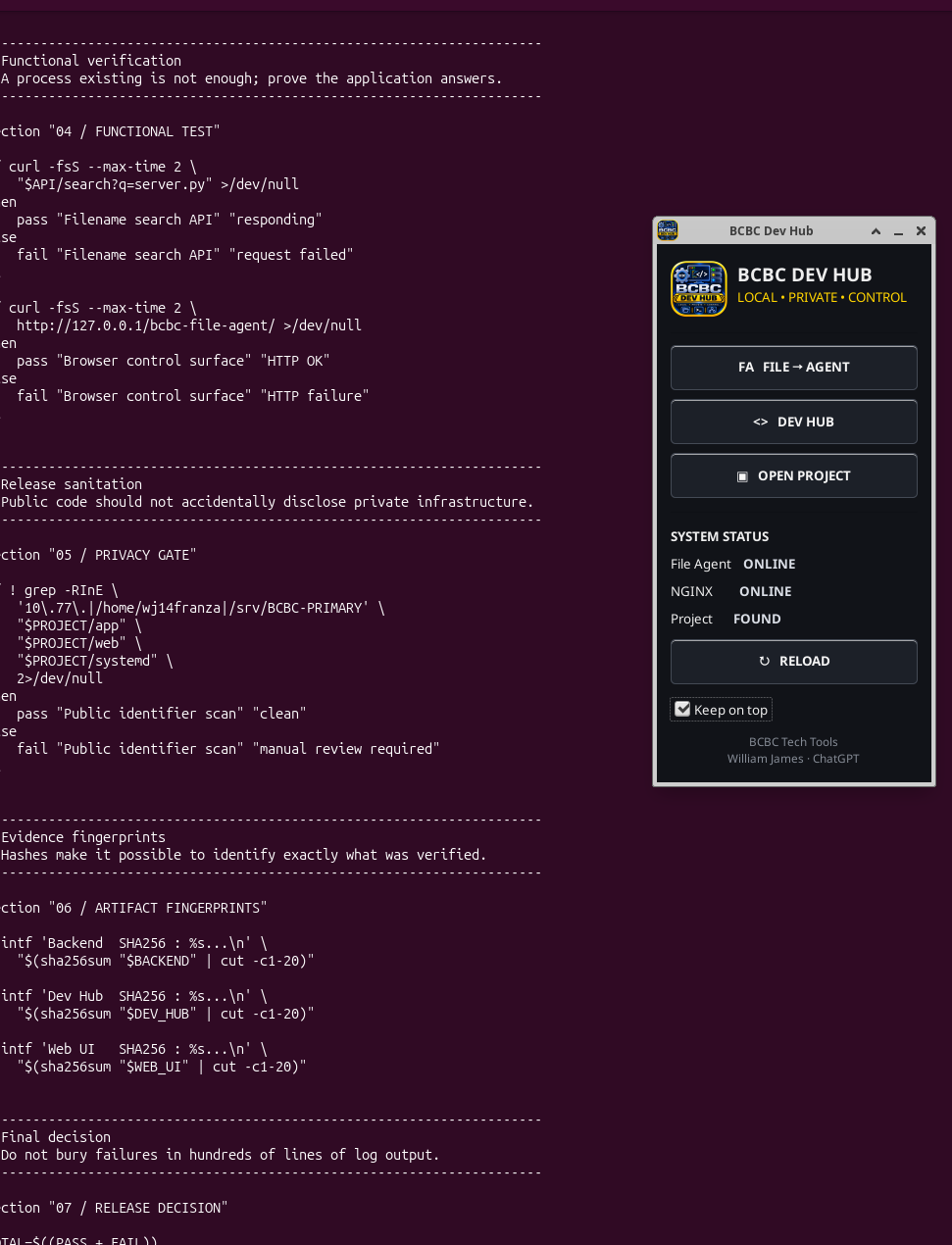
I also built a compact GTK control surface for the workflow.
FILE → AGENT
DEV HUB
OPEN PROJECT
plus immediate state:
File Agent   ONLINE / OFFLINE
NGINX        ONLINE / OFFLINE
Project      FOUND / MISSING
The point is not to build another large dashboard.
The point is to remove small pieces of friction that recur dozens of times during a development session.
One debugging lesson from the build
At one point the source code clearly implemented an HTTP GET handler, but requests returned:
501 Unsupported method ('GET')
The tempting response would have been to keep modifying the source.
The source was not the problem.
An older foreground Python process was still holding port 8765.
The important comparison became:
socket listener PID
        vs.
systemd MainPID
They did not match.
Once the stale process was terminated and the actual service restarted, the endpoint behaved correctly.
Verify the contract, not merely the appearance of health.
A green service status does not prove the expected process owns the expected socket.
A running process does not prove the application endpoint works.
Another small lesson: remove features too
During development I experimented with:
Classic / Modern modes
Narrow / Wide layouts
colored status indicators
They were eventually removed.
The simpler display:
ONLINE
OFFLINE
FOUND
MISSING
communicated everything necessary with less rendering logic and less UI complexity.
If a feature does not materially improve the workflow, it does not earn permanent complexity.
Release verification
I also built a read-only release preflight that checks:
artifact presence
Python syntax
systemd state
NGINX state
listener state
HTTP behavior
privacy/sanitation
artifact SHA-256 fingerprints
The intent is to preserve evidence of what was actually verified rather than relying on “it worked when I clicked it.”
Why I think this area matters
AI models are becoming increasingly capable, but there is still significant friction in the systems surrounding them:
artifact discovery
context selection
handoffs
state preservation
observability
failure diagnosis
workflow continuity
Improving those interfaces can sometimes produce more practical value than adding another layer of model complexity.
This project is intentionally small, but it is exploring that boundary.
Current state
Working locally now:
Filename Search
Content Search
Exact Path staging
Multiline command buffer
Python backend
NGINX frontend
systemd service
GTK Dev Hub
runtime state verification
release-preflight checks
engineering documentation
I am now packaging the sanitized public repository and documentation.
The GitHub URL will be added here as soon as the repository is published.
Feedback
I would especially like feedback from developers using Codex or other coding-agent workflows:
- How are you currently finding and handing local artifacts to agents?
- Is content search useful in your workflow?
- Would automatically generated manifests/checksums help?
- Would you prefer a CLI alongside the browser interface?
- What part of local-file/context handoff still wastes the most time for you?
The project is deliberately trying to solve the workflow problem first rather than accumulate features.
I’m currently interested in opportunities involving AI developer tooling, agent workflows, model-behavior evaluation, systems engineering, and developer infrastructure.
If your team is working on problems involving agent consistency, context management, workflow continuity, or human/AI interaction, I’d be particularly interested in talking.